


By Dr Pooja Chahwala
Consultant Psychiatrist
Feb 06, 2026
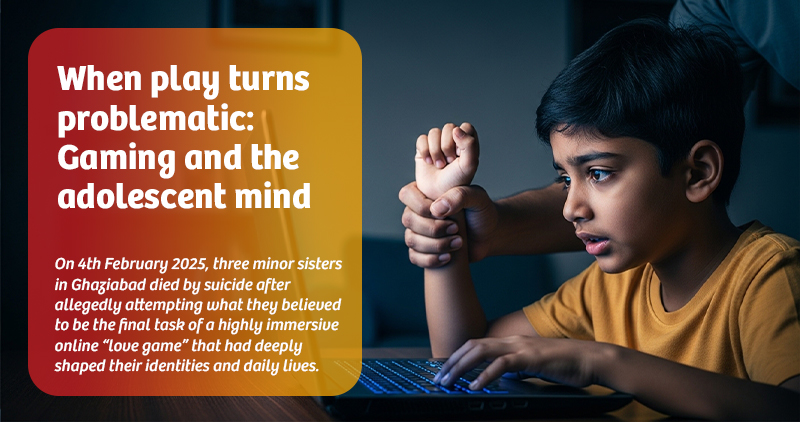
On 4th February 2025, three minor sisters in Ghaziabad died by suicide after allegedly attempting what they believed to be the final task of a highly immersive online “love game” that had deeply shaped their identities and daily lives. The tragedy sent shock waves across the nation and highlighted how digital games can move beyond entertainment and quietly take control of vulnerable adolescent minds. As gaming nowadays has become an inseparable part of teenage life, it is increasingly important to understand when play stops being healthy and begins to cause real psychological harm. This article explores how adolescent brain development, modern game design and social pressures can combine to turn gaming into a serious mental-health risk.
The adolescent years mark a critical period of brain development, particularly in areas responsible for impulse control, decision-making, and reward processing. This developmental stage coincides with peak gaming engagement, creating a unique intersection that deserves careful attention.
According to recent research, approximately 90% of teenagers play video games in some capacity, and around 12% are at risk of problematic gaming behaviour. According to the WHO, 34% of people play digital games daily, with more than 1 in 5 playing for 4 or more hours on days they game.
A lot of games feature violent themes or sexual content, such as sexual assaults and school shootings. For a growing subset of young people, gaming evolves from casual entertainment into a compulsive behaviour that interferes with daily functioning.
To understand why gaming can become problematic, we must first recognise what makes it so compelling to the adolescent brain. Video games are deliberately designed to stimulate the release of dopamine, the neurotransmitter associated with pleasure and reward. This neurochemical response is particularly powerful during adolescence, when the brain’s reward system is hypersensitive. Games employ sophisticated psychological mechanisms, including variable reward schedules, achievement systems, and social validation through leaderboards and multiplayer interactions. These elements create a “compulsion loop,” where the anticipation of rewards keeps players engaged far longer than they initially intended.
The adolescent prefrontal cortex, still under development, struggles to exert executive control over these powerful reward signals. This neurological vulnerability explains why teenagers are particularly susceptible to excessive gaming behaviours.
Distinguishing between enthusiastic gaming and problematic gaming requires attention to specific behavioural patterns. Parents and caregivers should watch for these red flags
When gaming consistently interferes with homework completion, studying, or school attendance, it indicates a concerning shift in priorities. Falling grades, missed assignments, and a lack of interest in academic achievement often accompany problematic gaming.
While online gaming involves social interaction, problematic gamers often abandon in-person relationships. They may skip family gatherings, avoid friends who do not game and show diminishing interest in activities they once enjoyed.
Late-night gaming sessions that result in chronic sleep deprivation represent a serious concern. Adolescents require 8–10 hours of sleep for proper development, and sleep deprivation from excessive gaming can negatively impact mood, cognitive function, and physical health.
Intense emotional reactions when unable to play, including anger, anxiety or low mood, suggest unhealthy dependence. Gaming becomes a primary mood regulator rather than one coping tool among many.
Lying about gaming time, hiding devices or creating secret accounts to bypass restrictions indicates awareness that gaming has become problematic, yet an inability to self-regulate.
Skipping meals, neglecting personal hygiene or ignoring physical discomfort to continue gaming shows how the behaviour overrides basic self-care.
Problematic gaming often overlaps with other psychological difficulties, and research increasingly points to a bidirectional relationship between excessive gaming and conditions such as depression, anxiety and attention-deficit disorders. For many adolescents, gaming becomes an escape from academic stress, social rejection or family conflict. The immersive nature of games offers short-term emotional relief, but over time, this avoidance strategy prevents young people from developing healthier ways of coping with stress and failure.
Gaming can also affect self-esteem in complex ways. In-game success and virtual status may offer momentary validation, but these achievements do not easily translate into real-world competence. This can widen the gap between virtual confidence and everyday functioning, leading to increased feelings of inadequacy outside the gaming environment.
Social development is another important concern. Although online gaming includes communication, it does not replace the richness of face-to-face interaction. Excessive gaming during crucial developmental years may limit opportunities to practice reading social cues, managing real-world conflict and building emotionally deep relationships.
Modern games are deliberately engineered to maximise engagement. Many popular titles use “endless” progression systems with no natural stopping points, continually offering new levels, rewards or challenges just beyond reach.
Free-to-play games with in-app purchases introduce additional risks, especially when they include loot-box or chance-based mechanics that resemble gambling. These features are particularly problematic for adolescents who are still developing impulse control and financial understanding.
Live-service models and limited-time events also create a powerful fear of missing out (FOMO). Players feel pressure to log in daily or participate constantly to remain competitive or maintain social status within their gaming community. Gaming transitions from being a leisure activity to becoming an obligation.
For some children, gaming gradually shifts from a form of play to a primary means of escape. When online identity begins to replace real-world connections, in-game failures can feel like personal failures, deeply affecting self-worth. Without healthy boundaries, excessive gaming can intensify existing emotional distress and vulnerability.
Effective approaches focus on clear, consistent and collaboratively set boundaries. Families can agree on limits for gaming time, establish technology-free periods (such as during meals and before bedtime), and reinforce the expectation that schoolwork and responsibilities take priority.
Encouraging a broader range of activities is equally important. Sports, creative hobbies, clubs, and offline friendships provide healthy alternatives for enjoyment, achievement, and meaningful social connection.
Open communication about what they see and experience online plays a central role. Keep gaming in shared spaces, not behind closed doors. Watch for warning signs and don’t hesitate to seek professional help.
Some situations go beyond what families can manage alone. Professional support should be considered when gaming is associated with
Mental-health professionals who work with adolescents can help identify underlying vulnerabilities and develop structured treatment plans.
From a psychiatrist’s lens, adolescent gaming reflects a complex interaction between a developing brain, heightened reward sensitivity, emotional regulation challenges, and unmet psychosocial needs. While gaming can enhance skills such as problem-solving and social bonding, excessive use may mask or exacerbate underlying conditions like ADHD, anxiety, depression, or emerging behavioural addictions. Early clinical cues can be significant. A balanced approach that assesses function rather than screen time alone is key to identifying when gaming shifts from recreation to a mental health concern.
