

By Dr Digish Shah
Senior Consultant Nuclear Medicine
March 12, 2026
At KD Cancer Centre, we recognise the importance of providing patients and families with clear answers and appropriate treatments while minimising stress. Our Nuclear Medicine Department integrates advanced molecular imaging, theranostics, and targeted nuclear therapy to enable early disease detection and guide precise treatment, while keeping patient comfort and safety at the centre of everything we do.
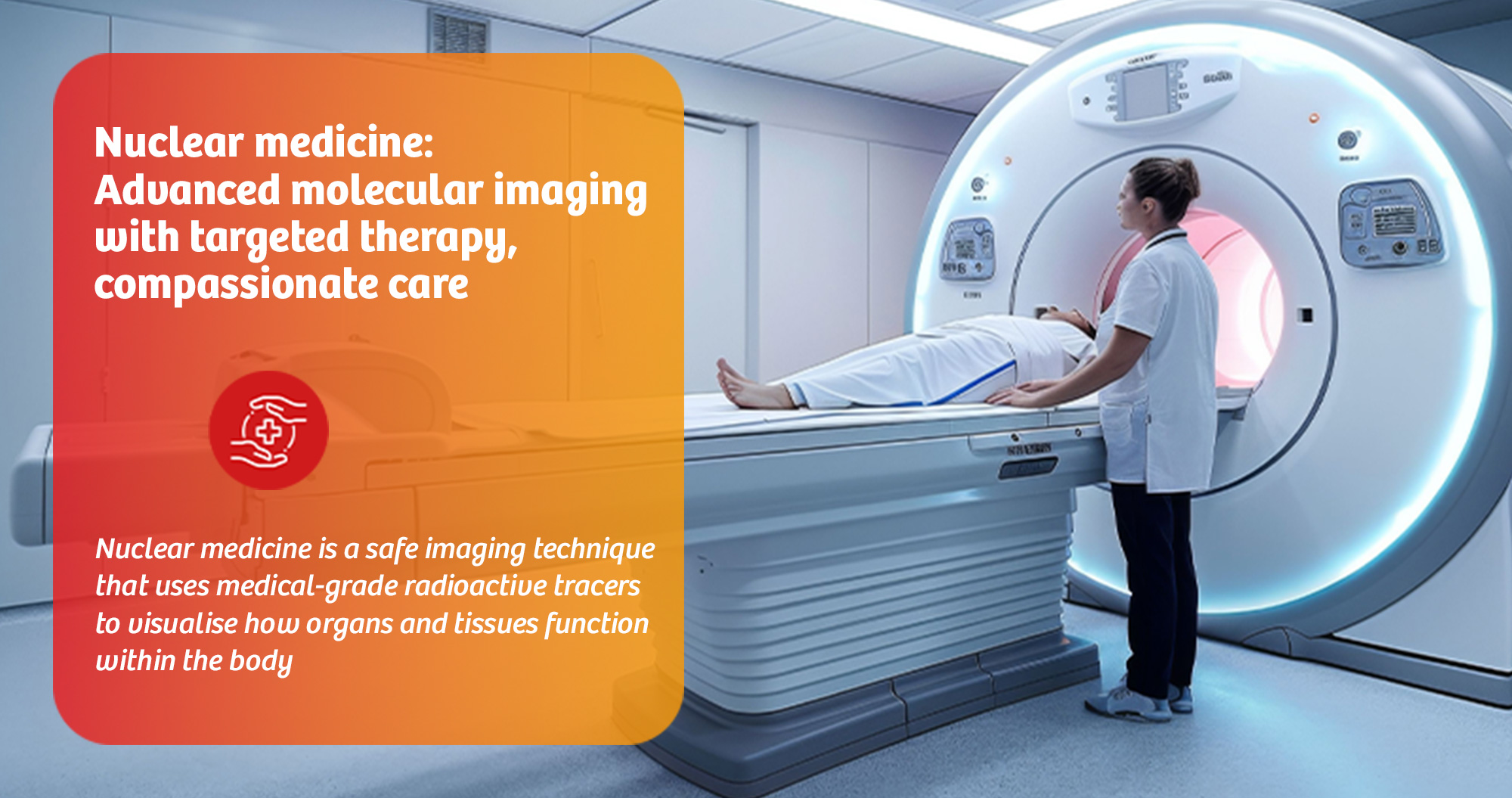
Nuclear medicine is a safe imaging technique that uses medical-grade radioactive tracers to visualise how organs and tissues function within the body, helping doctors detect diseases early and plan more precise treatments.
Unlike routine scans that show structure, nuclear medicine reveals the functionality of organs and disease. This helps doctors to:
We offer a full range of modern nuclear medicine investigations to support accurate diagnosis and effective treatment planning.
Our next-generation digital PET-CT system delivers exceptional accuracy for the early detection of cancer and for monitoring treatment response.
In addition to oncology, it also supports cardiac and neurological evaluations, making it a powerful tool for comprehensive patient care.
For many conditions, a PET-CT scan may not be required. Our gamma camera and SPECT studies provide reliable and accurate answers in a convenient outpatient setting.
These scans help to:
The procedure is simple, painless and safe—and most patients return home the same day.
Beyond diagnosis, our department also provides targeted nuclear therapy in specially designed and shielded treatment rooms.
At KD Cancer Centre, nuclear medicine is not only about advanced machines—it is about delivering peace of mind. From your first scan to ongoing therapy, our team is dedicated to ensuring that every patient feels safe, informed and supported.
1. Is nuclear medicine safe?
Yes. The amount of radiation used is low and comparable to other commonly performed imaging tests. We strictly follow international safety standards and low-dose protocols wherever possible.
2. What conditions can be detected using nuclear medicine?
Nuclear medicine is commonly used for:
Cancer – early detection, staging and treatment monitoring
Cardiology – assessing blood flow and heart function
Neurology – evaluating conditions such as epilepsy and dementia
Other organs – thyroid, kidneys, liver, bones and lungs
3. What is the difference between PET-CT, SPECT and gamma camera scans?
4. How should I prepare for a PET-CT or SPECT scan?
Preparation varies depending on the type of scan. Common instructions may include:
Our team will give you clear and personalised instructions before your appointment.
5. How long does the scan take?
6. Will the scan be painful?
No. Nuclear medicine scans are painless. You might feel a slight pinprick during the tracer injection, akin to a standard blood test.
7. When will I receive my results?
Our nuclear medicine specialists review the scans promptly. Reports are usually shared with your treating doctor within 24–48 hours.
8. What is nuclear therapy, and who may need it?
Nuclear therapy uses targeted radioactive medicines to treat selected conditions, such as certain thyroid disorders and specific cancers. At KD Hospital, therapy is delivered in dedicated shielded rooms under close medical supervision to ensure both safety and effectiveness.
At KD Cancer Centre, our nuclear medicine services use advanced technology and clinical expertise, combined with a truly patient-centred approach, to provide accurate diagnosis and targeted treatments with confidence and care. Whether it is early detection through PET-CT and SPECT imaging or precision-guided nuclear therapy, every service is designed to support timely decisions, better outcomes and a safer, more comfortable experience for patients and families.
From the first consultation to follow-up care, our dedicated team remains committed to one goal — providing reliable answers, personalised treatment pathways and compassionate support. Every patient can move forward with clarity, trust and peace of mind.
