


By Dr Kartik Desai
Consultant Gastroenterologist
Jan 13, 2026
When it comes to diagnosing complex digestive disorders, particularly those affecting the movement and function of the gastrointestinal tract, manometry has become an indispensable diagnostic tool. KD Hospital, recognised for its comprehensive gastroenterology services, offers advanced manometry testing that helps physicians accurately diagnose and treat a wide range of motility disorders. This detailed guide explores the manometry services available at KD Hospital and how this specialised testing can provide answers for patients struggling with digestive issues.
Manometry is a sophisticated diagnostic procedure that measures the strength, coordination, and pattern of muscle contractions in the gastrointestinal tract. Unlike imaging tests that show the structure of organs, manometry provides functional information about how well the digestive system is working. The test uses a thin, flexible catheter equipped with pressure sensors that measure the pressure and muscular activity at various points along the digestive tract.
The term “manometry” is derived from “mano,” meaning pressure, and “metry,” meaning measurement, together referring to the measurement of pressure. This procedure is particularly valuable because many digestive problems are caused not by structural abnormalities but by functional issues—situations where the organs look normal but don't work properly. Manometry can detect these functional problems with remarkable precision, providing crucial information that guides treatment decisions.
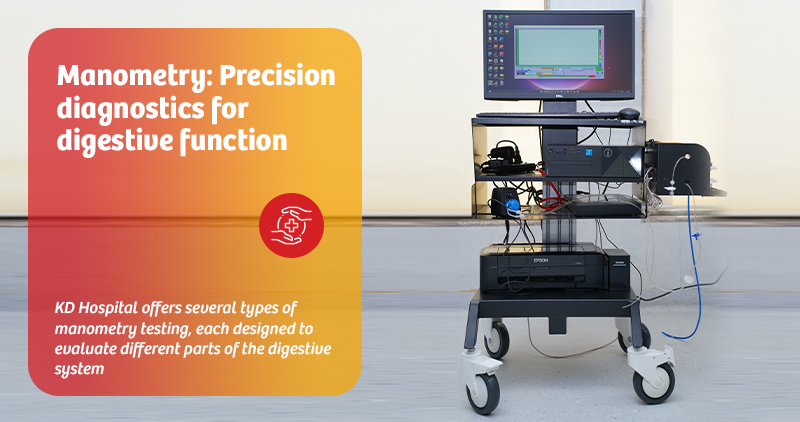
KD Hospital offers several types of manometry testing, each designed to evaluate different parts of the digestive system:
High-resolution oesophageal manometry
KD Hospital utilises state-of-the-art high-resolution manometry systems that provide detailed pressure measurements along the entire length of the oesophagus. This advanced technology offers superior diagnostic accuracy compared to conventional manometry.
Hirschsprung’s disease & anorectal manometry
Anorectal manometry is a crucial diagnostic test for evaluating Hirschsprung's disease, particularly in assessing the absence of the rectoanal inhibitory reflex (RAIR). This helps in early diagnosis and appropriate treatment planning for children with chronic constipation.
Biofeedback therapy for constipation
Biofeedback therapy, guided by anorectal manometry, is an effective, non-invasive treatment for children with functional constipation and defecation disorders. It helps patients learn proper coordination of pelvic floor muscles, improving bowel movements and overall quality of life.
Anorectal manometry
This specialised test assesses the function of the anal sphincters and rectum. It helps assess conditions such as chronic constipation, faecal incontinence, and other pelvic floor disorders.
Conditions diagnosed through manometry
The comprehensive manometry services at KD Hospital help diagnose numerous digestive disorders that might otherwise remain undetected or misdiagnosed. Understanding these conditions can help patients recognise when manometry might be beneficial.
Achalasia is a condition in which the lower oesophageal sphincter fails to relax properly, leading to difficulty in swallowing and the passage of food into the stomach. Manometry is considered the gold standard for diagnosing achalasia, and early detection through manometry testing at KD Hospital can lead to prompt treatment and symptom relief.
Oesophageal motility disorders
Various conditions affect how the oesophagus moves food from the throat to the stomach. These include diffuse oesophageal spasm, nutcracker oesophagus, and ineffective oesophageal motility. Manometry can precisely identify these conditions and distinguish between them.
Gastroesophageal reflux disease (GERD)
Before anti-reflux surgery, manometry is essential to ensure the oesophagus is functioning properly. KD Hospital's gastroenterology team uses manometry to evaluate patients being considered for surgical treatment of GERD.
Chronic constipation
Anorectal manometry at KD Hospital helps identify whether constipation is caused by pelvic floor dysfunction, inadequate rectal sensation, or sphincter problems. This information is crucial for selecting the most effective treatment approach.
Faecal incontinence is a condition that can significantly affect quality of life, leading to physical discomfort and emotional distress, but effective evaluation and treatment options are available. Anorectal manometry can identify weakness in the anal sphincters or abnormal rectal sensation that contributes to incontinence.
Non-cardiac chest pain
When heart-related causes have been ruled out, oesophageal manometry can identify oesophageal spasm or other motility disorders that may be causing chest pain.
KD Hospital has established itself as a centre of excellence for gastrointestinal diagnostics, and its manometry services exemplify this commitment to quality care. Several factors make KD Hospital the preferred choice for patients requiring manometry testing.
The hospital has invested in the latest high-resolution manometry equipment, which provides significantly more detailed information than conventional systems. This advanced technology enables more accurate diagnoses and supports more effective treatment planning.
The high-resolution systems at KD Hospital capture pressure data from numerous sensors simultaneously, creating detailed topographic maps of oesophageal function that make subtle abnormalities easier to detect.
Furthermore, KD Hospital's gastroenterology department is staffed by specialists who have extensive experience in performing and interpreting manometry studies.
These physicians understand the nuances of motility disorders and can distinguish between normal variations and clinically significant abnormalities. Their expertise ensures that patients receive accurate diagnoses and appropriate treatment recommendations.
Understanding what to expect during a manometry procedure can help alleviate anxiety and ensure patients are properly prepared. KD Hospital's patient-centred approach emphasises clear communication and comfort throughout the testing process.
Pre-procedure preparation: Before the test, patients meet with their gastroenterologist to discuss the procedure, review their symptoms, and address any concerns. For oesophageal manometry, patients are typically asked to fast for several hours before the test. Certain medications, particularly those affecting gastrointestinal motility, may need to be temporarily discontinued. The team at KD Hospital provides detailed written instructions to ensure proper preparation.
During the procedure, for oesophageal manometry, the procedure begins with the application of a local anaesthetic to one nostril to minimise discomfort. The thin manometry catheter is then gently passed through the nose, down the oesophagus, and into the stomach. While this may cause some initial discomfort, the sensation typically subsides quickly. Once the catheter is properly positioned, patients are asked to swallow small amounts of water at regular intervals while the catheter records pressure measurements.
The test typically takes 30 to 45 minutes for oesophageal manometry, though the duration varies depending on the type of manometry being performed. Throughout the procedure, KD Hospital's skilled technicians and nurses provide support and guidance, ensuring patient comfort and cooperation.
Anorectal manometry involves placing a small catheter into the rectum to measure sphincter pressures and rectal sensation. Patients may be asked to squeeze, relax, and bear down to assess different aspects of pelvic floor function. This test is generally well-tolerated and causes minimal discomfort.
Post-procedure care: One of the advantages of manometry is that it's a non-invasive procedure with minimal side effects. Most patients can resume normal activities immediately after the test. Some individuals may experience a mild sore throat after oesophageal manometry, which typically resolves within a day. The nursing staff at KD Hospital provides post-procedure instructions and is available to address any concerns that arise after patients return home.
The interpretation of manometry data requires specialised expertise, and KD Hospital's gastroenterology team excels in this area. The pressure measurements and contraction patterns recorded during manometry are analysed using established diagnostic criteria, and the results are compiled into a comprehensive report.
For oesophageal manometry, the report includes information about the resting pressure of the lower oesophageal sphincter, the relaxation of the sphincter during swallowing, the strength and coordination of oesophageal contractions, and the presence of any abnormal contraction patterns.
High-resolution manometry at KD Hospital presents this information in colour-coded topographic plots that make abnormalities visually apparent.
Following the procedure, patients typically have a follow-up appointment to discuss the results with their gastroenterologist. The physician explains the findings in understandable terms, discusses their clinical significance, and recommends appropriate treatment options based on the diagnosis.
The true value of manometry lies in treatment decisions. KD Hospital's multidisciplinary approach ensures that manometry results are integrated into comprehensive treatment plans tailored to each patient's specific condition.
For patients diagnosed with achalasia, treatment options might include pneumatic dilation, surgical myotomy, or injection of botulinum toxin. The specific manometry findings help determine which approach is most appropriate. Patients with other oesophageal motility disorders might benefit from medications that relax the oesophageal muscles, dietary modifications, or swallowing therapy.
When anorectal manometry identifies pelvic floor dysfunction, patients at KD Hospital may be referred for biofeedback therapy, a highly effective treatment that retrains the pelvic floor muscles. For sphincter weakness, other interventions might be recommended.
KD Hospital's commitment to staying at the forefront of medical technology ensures that patients benefit from the most advanced diagnostic capabilities available. The hospital regularly updates its equipment and adopts new manometry protocols as they're validated by research. This dedication to innovation means that patients receive the highest quality diagnostic testing available.
The hospital's high-resolution manometry systems provide unprecedented detail about oesophageal function, identifying subtle abnormalities that conventional manometry might miss. This enhanced diagnostic capability translates to more accurate diagnoses and better treatment outcomes for patients.
Beyond the technical excellence of its manometry services, KD Hospital distinguishes itself through comprehensive patient support. The hospital's patient care coordinators assist with appointment scheduling, insurance verification, and answering questions about procedures. Nutritionists and dietitians are available to guide dietary modifications that may help manage motility disorders.
The gastroenterology department also offers education sessions where patients can learn more about their conditions and treatment options. This educational approach empowers patients to take an active role in managing their digestive health.
Manometry represents a crucial diagnostic tool for evaluating gastrointestinal motility disorders, and KD Hospital offers this specialised testing with exceptional quality and expertise. From state-of-the-art high-resolution equipment to experienced gastroenterologists and compassionate support staff, every aspect of the manometry program at KD Hospital is designed to provide patients with accurate diagnoses and effective treatment pathways.
For individuals experiencing unexplained swallowing difficulties, chest pain, chronic constipation, or faecal incontinence, manometry testing at KD Hospital can provide the answers needed to move forward with appropriate treatment. The hospital's commitment to diagnostic excellence, combined with its patient-centred approach, makes it an ideal choice for anyone requiring manometry services.
By choosing KD Hospital for manometry testing, patients gain access to advanced technology, specialised expertise, and comprehensive care that addresses both the diagnostic process and the journey toward improved digestive health and quality of life.
