


By Dr Pooja Chahwala
Consultant Psychiatrist
March 05, 2026
You told yourself you'd check your phone for five minutes. That was forty-five minutes ago. Now you're three hundred posts deep into a feed full of headlines that make your stomach drop, your chest feel tight, and your mind race, and you still can't put it down. Welcome to doom scrolling. And if your brain already leans toward anxiety, this habit isn't just a time-waster. It's a trap, and understanding exactly why it works on you is the first step toward escaping it.
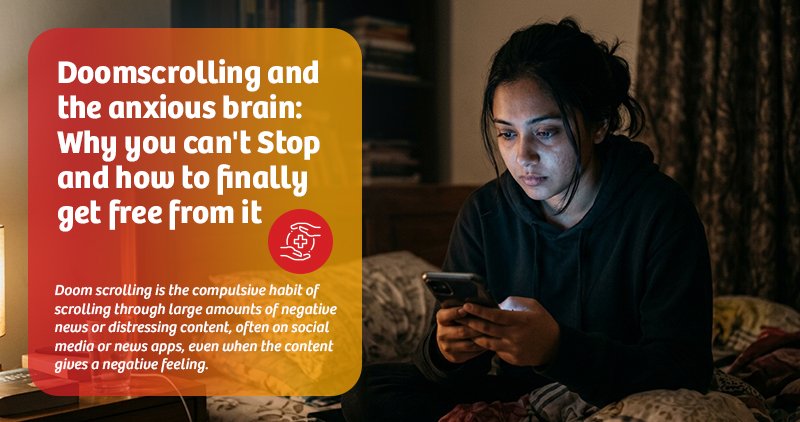
Doom scrolling is the compulsive habit of scrolling through large amounts of negative news or distressing content, often on social media or news apps, even when the content gives a negative feeling. The term entered mainstream conversation in 2020, but the behaviour itself is far from new — it has been amplified and accelerated by the design of modern digital platforms.
On the surface, doom scrolling looks passive. You're just reading. But underneath, your brain is engaged in a highly active cycle of seeking, consuming, and reacting. And for people who already struggle with anxiety, this cycle hits different. It doesn't just waste time. It actively feeds the anxious brain's deepest instincts.
To understand why doom scrolling is so addictive — especially for anxious people — you need to understand a few key features of how the anxious brain works.
The threat-detection system is on overdrive. Anxiety is, at its core, the brain's alarm system firing too frequently or too loudly. An anxious brain is constantly scanning for danger. News feeds and social media are essentially infinite streams of potential threats — political crises, natural disasters, health scares, social conflicts. For an anxious brain, each one triggers the same basic response: pay attention, stay informed, don't look away. The logic is primal: if you know about a threat, you're better equipped to survive it.
Uncertainty is the real enemy. Anxious brains are wired to hate uncertainty more than bad outcomes. Ironically, doom scrolling often makes uncertainty worse — you're consuming fragmented, incomplete, and contradictory information. But the act of searching for answers feels productive. It gives the anxious mind something to do with all that restless energy, even when the "doing" is actually making things worse.
The dopamine loop doesn't care about how you feel. Here's the uncomfortable truth: your brain's reward system doesn't distinguish between good and bad stimulation. Dopamine — the chemical associated with motivation and seeking — surges not just when you feel good, but whenever you encounter something novel or surprising. Every new headline, every scroll, every notification delivers a hit. And because anxiety already keeps your nervous system on high alert, these dopamine spikes can feel almost addictive. You're not scrolling because you enjoy it. You're scrolling because your brain is chemically rewarding you for doing it.
The illusion of control. For someone whose inner world feels chaotic and unpredictable, staying "informed" about the outside world can feel like a form of control. Doom scrolling becomes a coping mechanism — a way to manage the discomfort of anxiety by constantly monitoring what's happening out there. The problem is that this sense of control is completely illusory. Reading about a crisis on the other side of the world doesn't actually give you any power over it.
If you doom scroll regularly and struggle with anxiety, you're not imagining the toll it takes. Research consistently links excessive consumption of negative news to increased levels of anxiety, depression, and stress. However, beyond the studies, the effects manifest in daily life in ways that are difficult to overlook.
Sleep suffers. Anxious brains already have trouble shutting down at night, and doom scrolling — especially in the hour before bed — floods your system with stress hormones and keeps your mind wired and racing long after you've put the phone down. The quality of your sleep drops, which makes your anxiety worse the next day, which makes you more likely to doomscroll again. It's a brutal cycle.
Your sense of the world becomes distorted. News algorithms are designed to surface the most emotionally charged content. When that's all you're consuming, your brain starts to believe that the world is far more dangerous, chaotic, and hopeless than it actually is.
Your present moment disappears. Doom scrolling pulls you completely out of whatever you're actually doing and feeling right now. For anxious people, who already struggle to stay grounded in the present, this makes the anxiety significantly worse — because anxiety thrives in the gap between where you are and where your mind thinks you should be.
Knowing why you doom scroll is powerful, but it's not enough on its own. Here are strategies that work with your anxious brain rather than against it.
Set intentional news windows. Instead of letting news trickle in all day through your feed, designate one or two short windows — maybe fifteen minutes in the morning and fifteen in the evening — where you consciously check the news. Outside of those windows, the news app stays closed. This gives your brain its need for information without letting it run the show all day.
Use friction to your advantage. The reason doomscrolling is so easy is that there's zero friction between the impulse and the action. Make it harder. Delete news apps from your phone. Turn off notifications. Use a website blocker during certain hours. The more steps between you and the scroll, the more space you create for a conscious choice.
Name what's actually happening. When you catch yourself mid-scroll and feel that familiar knot of anxiety tightening, pause and name it out loud or in your head: "I'm anxious. I'm doom scrolling. It isn't helping me." Research in psychology shows that simply labelling an emotion — a technique called "affect labelling" — can reduce the intensity of that emotional response. It interrupts the automatic pilot and brings your prefrontal cortex back into the conversation.
Replace the behaviour, don't just delete it. Willpower alone rarely wins against a deeply ingrained habit, especially one reinforced by dopamine. Instead of trying to white-knuckle your way through the urge to scroll, have a replacement ready. When the itch hits, reach for something that also gives your brain a hit of novelty or engagement — a podcast, a walk outside, a conversation with someone you trust, a book you're excited about.
Practice grounding, not just "mindfulness." Mindfulness is a wonderful practice, but telling an anxious person to "just be present" can feel dismissive and impossible. Grounding techniques are more concrete and work faster. Try the 5-4-3-2-1 technique: name five things you can see, four you can touch, three you can hear, two you can smell, and one you can taste. It pulls your nervous system back into the present moment and out of the doom feed in your head.
Talk to a professional if the anxiety runs deep. If doom scrolling feels compulsive — if you've tried to stop and genuinely can't, or if your anxiety is affecting your daily life beyond just your scrolling habits — please consider speaking with a mental health professional. Cognitive behavioural therapy, in particular, has strong evidence behind it for treating both anxiety and compulsive behaviours. You don't have to white-knuckle this alone.
Doomscrolling isn't a character flaw. It's the predictable result of an anxious brain meeting a digital environment specifically designed to keep it engaged. The platforms win because they understand your brain's threat-detection system, your hunger for information, and your dopamine-driven need for novelty — and they exploit all three.
But understanding the game changes everything. Once you see doom scrolling for what it actually is — a neurological loop, not a personal failure — you can start to work with your brain instead of blaming it. Set boundaries. Create friction. Ground yourself in the present. And remember: staying informed is important, but so is staying sane. You can have both.
