


By Dr Kush Shah
Consultant Urology
Apr 23, 2026
Kidney stones can cause some of the most intense physical pain a person will ever experience. If you’ve recently been diagnosed with one, your priority is likely to have it treated quickly and safely. Fortunately, modern urology offers several highly effective procedures to break down and remove these painful stones.
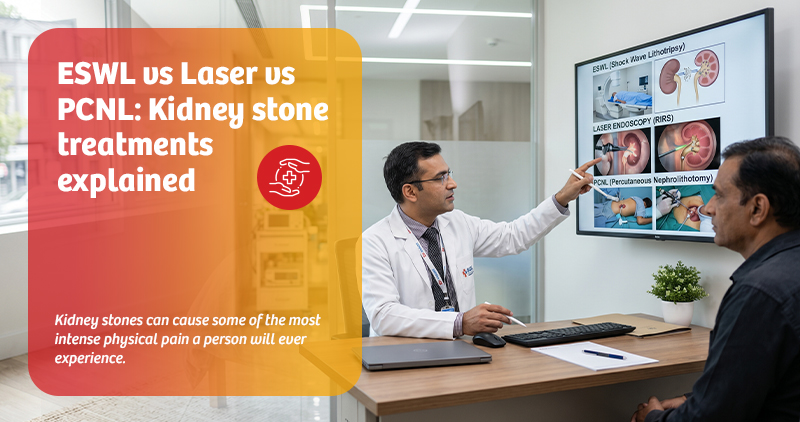
Choosing the right procedure depends heavily on the size, location, and hardness of the stone, along with your overall health. Your doctor will typically recommend one of three primary treatments: Extracorporeal shock wave lithotripsy (ESWL), laser lithotripsy (often performed during a ureteroscopy), or percutaneous nephrolithotomy (PCNL).
Understanding the differences between these options can help you feel more confident as you discuss a treatment plan with your urologist. Let us explore how each procedure works, its benefits, and who they are best suited for.
ESWL is a completely non-invasive procedure. It relies on targeted sound waves to break the kidney stone into tiny, sand-like pieces.
During the procedure, you lie on a specialised table while a machine generates high-energy shock waves. These waves travel through your body directly to the stone. Because the treatment happens entirely outside the body, there are no incisions. You will typically receive mild sedation or light anaesthesia to help you remain still and comfortable. After the stone is broken down, the small fragments pass naturally through your urinary tract over the following days or weeks.
The biggest advantage of ESWL is its non-invasive nature. Patients usually go home the same day and experience a relatively fast recovery. However, it is not always effective on very hard or very large stones. Sometimes, patients need a second treatment if the stone does not break apart completely. Passing the fragments can also cause some discomfort.
This procedure is most effective for patients with smaller stones (typically under 1 centimetre) located in the kidney or upper ureter. It is a great option for people who want to avoid surgery and have stones that show up clearly on X-rays.
Laser lithotripsy is a minimally invasive procedure. It uses a small camera and a highly focused laser to locate and destroy the kidney stone.
A urologist inserts a thin, flexible scope called a ureteroscope through the urethra and bladder, guiding it up into the ureter or kidney where the stone is lodged. Once the camera locates the stone, the doctor uses a thin laser fibre to blast the stone into dust or small fragments. The doctor can then use a tiny basket tool to remove the larger pieces immediately.
Pros and cons
Laser lithotripsy boasts a very high success rate. Because the doctor can physically see the stone and remove the pieces, you are less likely to need a repeat procedure. There are also no incisions involved. On the downside, it requires general anaesthesia. You may also need a temporary stent placed in your ureter to help with swelling, which can cause mild discomfort until it is removed a week or so later. Patients usually go home during the day, depending on recovery.
Ureteroscopy with laser treatment is highly versatile. It is ideal for mid-sized stones, stones lodged in the lower ureter, or stones that are too hard for ESWL shock waves to break.
PCNL is a surgical procedure designed for the largest and most complex kidney stones. It involves creating a small tract directly into the kidney from the back.
While you are under general anaesthesia, the surgeon makes a small incision (about the size of a dime) in your back. They insert a protective tube directly into the kidney. Using specialised instruments and a camera, the surgeon breaks the stone apart and suctions the pieces out.
Pros and cons
PCNL is highly efficient at clearing out massive amounts of stone material in a single setting. It is the gold standard for complex cases. However, because it is a surgical procedure, it carries a higher risk of bleeding and infection compared to ESWL and laser treatments. It also requires a brief hospital stay, usually one to two days, and a longer overall recovery time.
Urologists typically reserve PCNL for patients with very large stones (over 2 centimetres), staghorn calculi (stones that fill multiple branches of the kidney), or stones that other treatments have failed to clear.
How long does recovery take for these procedures?
Recovery varies by treatment. ESWL patients usually resume normal activities within one to two days. Laser lithotripsy patients might need a few days of rest, especially while a stent is in place. PCNL patients generally need one to two weeks of recovery due to the surgical incision.
Will I be asleep during the treatment?
Laser lithotripsy and PCNL almost always require general anaesthesia, meaning you will be completely asleep. ESWL often uses heavy sedation or general anaesthesia, depending on the specific equipment and the doctor's preference.
Can stones come back after treatment?
Yes. Breaking up a current stone does not prevent future stones from forming. Your doctor will likely recommend dietary changes, increased water intake, or medications to lower your risk of developing more stones.
Living with kidney stone pain is incredibly stressful, but you do not have to endure it indefinitely. By understanding the differences between ESWL, laser lithotripsy, and PCNL, you can have a more productive conversation with your medical team.
Schedule an appointment with a board-certified urologist to review your imaging results. They will consider the size and location of your stone, analyse your medical history, and help you select the safest and most effective path forward.
